Master Series
GEOMETRY, SOUL, AND LEGACY: CASA MUSEO EDGAR NEGRET
An exclusive conversation with Edgar Negret & Edgar David Buitrago
Niotah Journal · October 3, 2026
Niotah introduction
A pioneer of Latin American modern sculpture and a towering figure in 20th-century art, Edgar Negret transformed aluminum, geometry, and modular construction into a deeply personal spatial poetry. Today, the Casa Museo Edgar Negret in Bogotá not only preserves the essential chapters of his international trajectory, but also safeguards the profound human, social, and communal spirit of his former home. In this exclusive feature of the Niotah Master Series, we speak with Museum Director Edgar David Buitrago on carrying forward Negret’s vision, bridging historic heritage with contemporary creation, and sharing this enduring legacy with future generations
Visiting the Casa Museo Edgar Negret in Bogotá is an entry into a world where mathematical precision meets deep human warmth. While globally celebrated for its commanding abstract structures in metal, the true treasure of the museum lies in discovering the intimacy of what was, above all, the master’s home. What makes this space profoundly moving is Negret’s immense generosity—dedicating an entire building for his studio workers to live alongside him, reflecting a social consciousness rarely documented in art history.
Today, this living atmosphere is carried forward by Edgar David Buitrago, who grew up beside Negret as his confidant and was handpicked by the master to direct his legacy. Through Buitrago’s guidance, the cold rigidity of iron and aluminum is transformed into a living, deeply personal experience.
I. A Living Heritage in Bogotá
Niotah
Could you introduce the museum and share what makes it such a significant space within the cultural landscape of Bogotá?
Edgar Negret. An exclusive conversation with Edgar David Buitrago
In the context of Latin American art—and particularly in Colombia—a generation emerged in the mid-20th century that transformed modern sculpture: Fernando Botero, Alejandro Obregón, Enrique Grau, Eduardo Ramírez Villamizar, and Edgar Negret. Within this group, Negret developed a unique language where abstraction, geometry, and modular aluminum construction converged into spatial poetry.
The Casa Museo Edgar Negret was created precisely to preserve and transmit that journey. This space was his home and studio for decades. Walking through the museum does not mean merely contemplating a collection; it means traversing the time of an artwork and understanding how a Colombian artist built a universal language
Niotah
What was the original vision behind the museum, and how has that vision evolved over the years?
Edgar Negret. An exclusive conversation with Edgar David Buitrago
The vision began with master Negret himself, who envisioned creating a great museum to preserve and showcase his work for future generations. What we have done is continue the vision he conceived during his lifetime.
Building upon this, the museum’s role extends beyond exhibiting his work into educational, cultural, and social initiatives that connect with new artists and diverse audiences. We also foster international exchanges, bringing work by foreign artists to Colombia while projecting Colombian artists abroad. Today, operating active projects out of his former home and studio keeps master Negret’s vision alive, open, and constantly in motion.
Niotah
How does the museum bridge the preservation of Negret’s historic legacy with engaging contemporary artists and younger generations?
Edgar Negret. An exclusive conversation with Edgar David Buitrago
Preserving the Casa Museo Edgar Negret does not mean treating it as a static vault. The museum is, above all, a space of active dialogue. Throughout the year, we host educational workshops for young students, welcoming them to engage with Negret’s geometric language and translate those concepts into their own creative exercises.
Furthermore, Negret’s work remains remarkably visionary—built from aluminum, precise geometry, and space, many pieces carry a futuristic presence that resonates deeply with contemporary artists today. By offering residencies, exhibitions, and international exchanges, we ensure that his home continues to serve as an inspiring bridge between generations, geographies, and artistic perspectives.
II. The Evolution of Form & Future Vision
Niotah
Colombia features a very diverse and evolving art scene. How do you understand the relationship between Colombian artistic heritage and contemporary art practices?
Edgar Negret. An exclusive conversation with Edgar David Buitrago
In Colombian and Latin American art, there was a foundational generation often called 'the untouchables'—Botero, Grau, Ramírez Villamizar, Negret, and Obregón—who revolutionized modern sculpture during the 1960s and 70s. Master Negret’s legacy stands out for its unique constructivist, abstract, modular, geometric, and concrete language.
This carefully preserved museum displays works selected by master Negret himself across every stage of his career—showing how his work evolved from the 1940s before leaving the country, through New York and Paris in the 1950s, until selecting aluminum as his signature material to articulate his vision.
Niotah
From your perspective as Director, what do you consider to be the main challenges and opportunities for museums in Colombia today?
Edgar Negret. An exclusive conversation with Edgar David Buitrago
One of our primary goals is to bring master Negret’s work to international stages equal to his legacy, building partnerships with major institutions where he previously exhibited, such as MoMA, the Guggenheim, Petit Palais, and Musée Rodin.
Generating these connections is an ongoing challenge, particularly for an independent institution facing limitations in institutional support and resources. However, these obstacles drive us to work with greater determination. As master Negret used to say, pathways are opened through persistence. With that same spirit, we continue building alliances to ensure his work occupies the global stages it deserves.
Niotah
How do you find a balance between preserving an artistic legacy and keeping the museum connected with younger generations and contemporary cultural debates?
Edgar Negret. An exclusive conversation with Edgar David Buitrago
For us, preserving the Edgar Negret Museum does not mean merely conserving a space and a collection, but keeping the master's legacy alive and allowing his work to continue in active dialogue with new generations and contemporary art.
Edgar Negret’s work remains profoundly relevant. He was an artist ahead of his time, and many of his sculptures—built from geometry, space, and metal—feel like futuristic structures that have arrived from another moment to meet us today.
We want to keep that encounter alive. We love seeing contemporary artists, both Colombian and international, find inspiration in Negret as a connection to their own searches. This proves to us that his work does not belong solely to history, but continues to be part of the present. Our commitment is to keep his legacy open, accessible, and vibrant, because a body of work that continues inspiring and provoking conversations never ceases to be contemporary.
“A body of work that continues inspiring and provoking conversations never ceases to be contemporary.”
Niotah
Are there artists, movements, or cultural voices from Colombia that, in your opinion, deserve greater international visibility?
Edgar Negret. An exclusive conversation with Edgar David Buitrago
Yes. It is natural for new generations to find points of reference in Negret's language. Artists like Verónica Matiz, and Jesús Tibaduiza—who worked alongside master Negret for over 35 years before developing his own body of work—embody this connection.
Negret not only developed a modern geometric language, but also drew fundamental inspiration from pre-Columbian symbols, structures, and worldviews, reinterpreting them into a universal framework. The museum serves as a bridge, allowing artists to study his creative process and find elements to fuel their own paths.
III. International Horizons & The Soul of Art
Niotah
What aspect of the museum would you particularly like an international audience to discover through Niotah?
Edgar Negret. An exclusive conversation with Edgar David Buitrago
Cultural platforms like Niotah are essential tools for sharing knowledge and reaching new audiences. In complex times marked by uncertainty and transformation, culture offers another lens, opening conversations and igniting hope.
Our purpose is to bring master Negret’s work and philosophy to new countries, sharing a vision of art that goes beyond aesthetics. His legacy reminds us that creation, curiosity, and sensitivity can help us look at life with optimism, enthusiasm, and purpose.
Niotah
Looking toward the future, what would you like the museum to achieve or develop over the coming years?
Edgar Negret. An exclusive conversation with Edgar David Buitrago
In Colombia, there is still a long path to travel regarding institutional support, promotion, and visibility for the arts. While we see growing public interest today, independent institutions need greater accompaniment to reach broader audiences.
From the Edgar Negret Museum, we will continue working to gain greater recognition and opportunities for artists and their legacies. Strengthening support for culture is fundamental to preserving our identity, memory, and heritage.
Niotah
To conclude, what does art mean to you personally, and what continues to inspire you in the work you do?
Edgar Negret. An exclusive conversation with Edgar David Buitrago
Art is undoubtedly one of humanity's most profound forms of self-expression. From early cave paintings to contemporary creations, human beings have used art to communicate their desires, emotions, and inner soul. It preserves memory, carrying the social, political, and cultural moment in which it was born.
Master Negret used to say that an artist can “put their finger on the wound” or “show a path of salvation.” I deeply believe in that idea. Artists have the power to highlight what hurts, but also to open a window toward hope and remind us that, even in the most difficult times, light always exists..
“An artist can “put their finger on the wound” or “show a path of salvation.”
About the artist
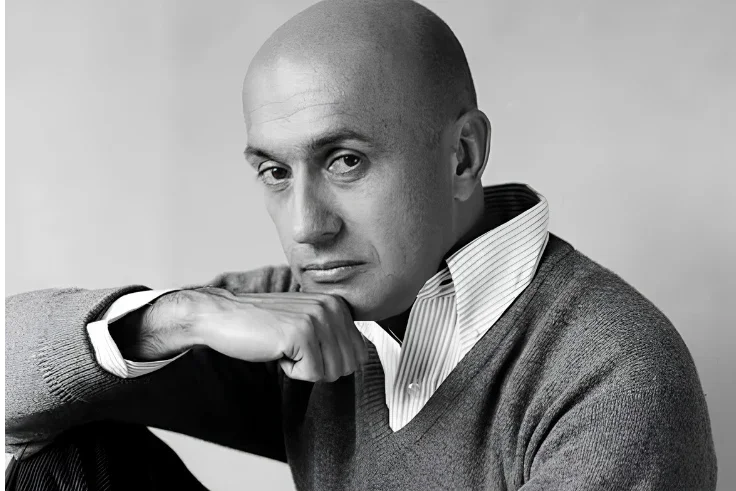
Edgar Negret & Edgar David Buitrago
Edgar Negret (1920–2012) was a monumental Colombian sculptor and a central figure in 20th-century geometric abstraction. Trained at the Escuela de Bellas Artes in Cali, Negret expanded his artistic language through extensive periods in New York, Paris, Barcelona, and Mallorca. It was during his time in New York that he embraced aluminum—a material he transformed from an industrial commodity into a sensitive, poetic medium capable of folding, reflecting light, and defining space. Celebrated alongside contemporaries like Fernando Botero, Alejandro Obregón, Enrique Grau, and Eduardo Ramírez Villamizar, Negret was instrumental in introducing modern art to Colombia and projecting Latin American sculpture onto the global stage. His work bridges rationality and spirituality, incorporating constructivist modularity with deep references to Pre-Columbian symbolism. Today, his former residence and studio in Bogotá stands as the Casa Museo Edgar Negret, preserving his living legacy and humanistic vision.
Commentary
0 notes
- Loading commentary…