What Is the Global South?
The term Global South appears increasingly in conversations about art, culture, economics, politics, and global exchange. But what does it actually mean?
The answer is more complex than geography.
The Global South does not simply refer to countries located in the southern half of the world. Nor is it a synonym for “developing countries.” It is a broad and evolving term used to describe regions and communities whose histories have often been shaped by colonialism, unequal global structures, economic dependency, migration, and struggles for cultural and political autonomy.
It includes much of Africa, Latin America, the Caribbean, the Middle East, South and Southeast Asia, and parts of Oceania. But there is no single map that defines it completely.
More Than Geography
One of the most important things to understand about the Global South is that it is not a single cultural identity.
An artist from Brazil does not necessarily share the same experience as an artist from Senegal, India, Tunisia, Colombia, or Iraq.
Each region has its own languages, histories, traditions, artistic practices, and contemporary realities.
The term instead creates a framework for recognizing experiences and histories that have often been positioned outside the dominant cultural centres of the global art world.
It asks us to look beyond a world organized around a small number of established cultural capitals.
A History of Unequal Exchange
The idea of the Global South is closely connected to the history of colonialism and the unequal distribution of economic and political power.
For centuries, resources, knowledge, cultural objects, and labour moved across borders through systems that did not distribute power equally.
These histories continue to influence contemporary societies — including their cultural institutions and art worlds.
Yet the Global South should not be understood only through hardship or inequality.
Its societies have also produced extraordinary intellectual, cultural, and artistic traditions that existed long before contemporary global classifications.
A Living Cultural Landscape
Today, artists across the Global South are working across painting, sculpture, photography, film, design, architecture, music, performance, digital media, and many other disciplines.
Many engage with heritage while simultaneously questioning it.
Some explore migration and displacement. Others address memory, identity, urban transformation, environment, spirituality, or the relationship between tradition and contemporary life.
Their practices demonstrate that cultural heritage is not static.
It moves.
It adapts.
It is reinterpreted by every generation.
Why Does the Term Matter in Art?
The global art world has historically given greater visibility to certain institutions, markets, museums, and cultural centres.
The term Global South can help shift that perspective.
It encourages us to ask:
Whose stories are being seen?
Whose histories are being preserved?
Whose artistic languages are being included in the conversation?
And perhaps most importantly:
Who gets to define what contemporary art looks like?
These questions do not mean that artists from the Global South should be understood only through their geography. Quite the opposite.
They should be encountered first as artists — with individual practices, ideas, histories, and voices.
From Geography to Dialogue
This is where the idea of Resonance of the South begins.
The exhibition does not attempt to present a single image of the Global South.
Instead, it brings different artistic voices into proximity.
Artists from different regions can share concerns while remaining deeply distinct. Their works may speak about memory, identity, belonging, heritage, displacement, transformation, or the future — each from a particular cultural and personal position.
The purpose is not to create uniformity.
It is to create dialogue.
Perhaps this is the most useful way to understand the Global South today: not as one place, and not as one story, but as a constellation of cultures, histories, experiences, and creative voices.
And when these voices meet, new connections become possible.
That is the resonance.
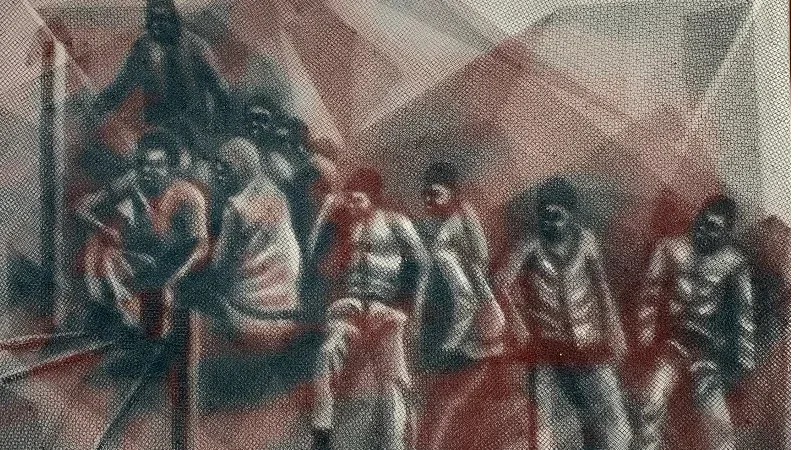
Artwork by Jean Marc Konan