The places that shape us are never made of geography alone. They remain within us through the people we knew there, the experiences we lived and the part of ourselves that came into being within them.
Memory often returns through place: a room, a street, the curve of a coastline or the particular light of an afternoon. Through that place, people, conversations and emotions begin to reappear.
A woman once explained this to me in a way I have never forgotten. She was born in Athens and had lived there all her life, but her parents came from Crete, where she spent every summer as a child. When I asked where she was from, she answered without hesitation:
“I am from Crete.”
Then she added, “Everyone has their own Crete.”
The outline of Crete is the same on every map. Yet no two people carry exactly the same Crete within them. For one, it may hold the freedom of childhood summers; for another, the memory of falling in love, discovering a place together or returning to where they feel they belong.
The external geography is shared. The inner geography is personal.
My own life has unfolded across very different parts of the world. I was born in Cuba, raised in Russia, spent many years in South Africa and eventually found my home in Greece.
For a long time, I thought of these places as separate chapters. Gradually, I came to understand that one had not replaced another. Each remained present within me, carrying different memories, emotions and parts of my identity.
This led me to the question at the centre of my artistic practice:
Why do some places remain with us long after we leave them?
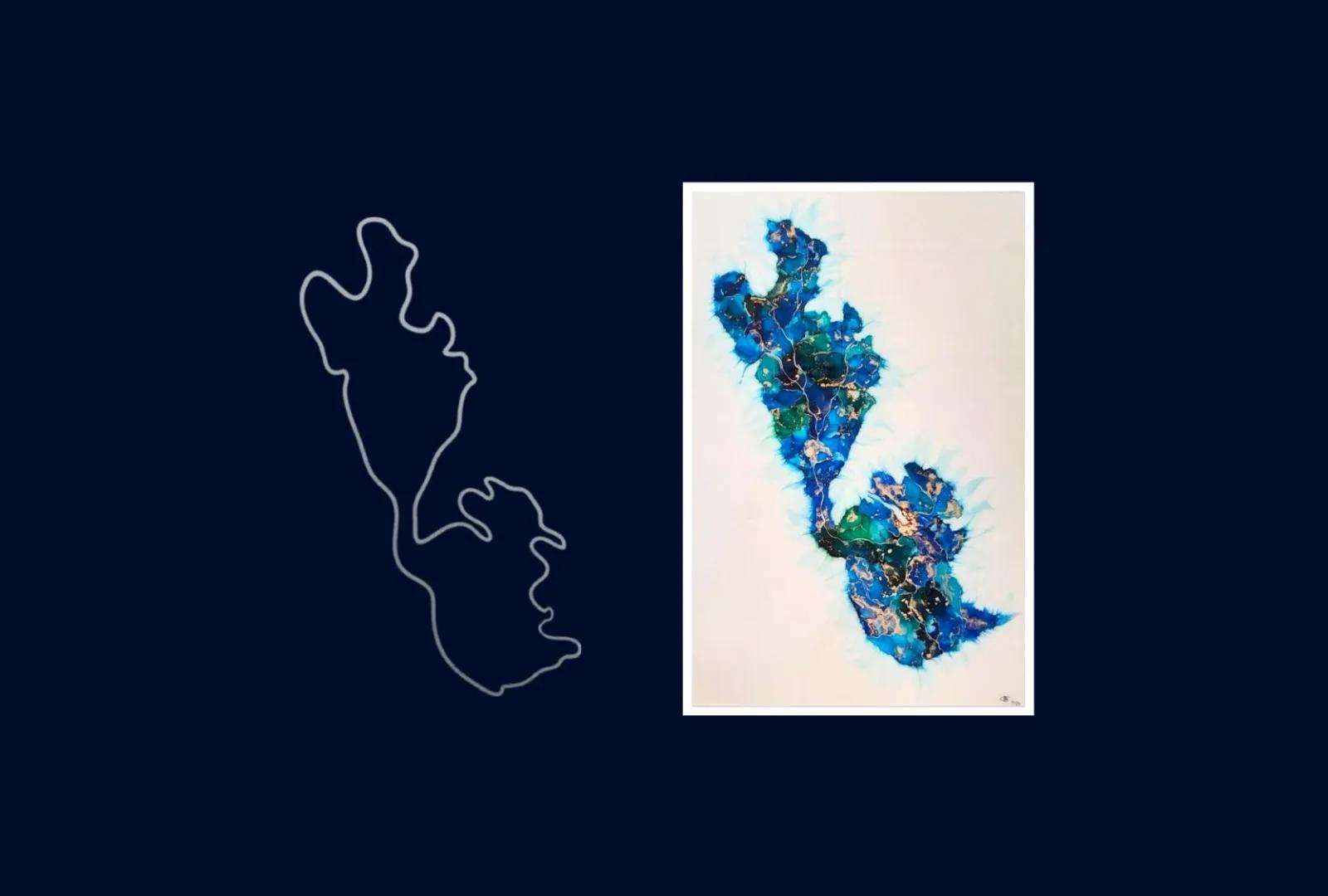
My work evolved in response to that question into what I call Abstractural Art—a visual language in which precise geography meets the emotional freedom of abstraction.
Each painting begins with a real location: an island, a coastline, a country or a city. I start with the recognisable form of the map because the physical truth of the place matters. Its contours and the relationship between land and water become the foundation of the work.
But a map can give us only the visible structure of a place. Painting allows me to explore what may exist beyond it: attachment, distance, belonging and return.
Within those contours, colour begins to move freely. As I listen to what the place evokes—and, in the case of a commission, to the stories connected to it—an emotional palette gradually emerges. Metallic lines move through the composition as pathways of connection rather than roads or borders.
The location remains recognisable, but it is no longer experienced simply as somewhere to be found. It becomes something to be felt.
When creating a work connected to another person’s story, I do not try to illustrate that story literally. A coastline where someone fell in love, an island to which a family returns each summer or a country left many years ago cannot be contained within a single image.
Instead, the painting becomes a point of connection.
Its meaning comes from two directions: from the visible landscape within the work and from the inner landscape carried by the viewer. Two people may recognise the same island, coastline or country, yet each will encounter something different within it.
This is where painting can move beyond the representation of location. It creates a meeting place between physical geography and personal experience, allowing something distant to become emotionally present again.
The geography begins with the place.
The memory belongs to the viewer.
The painting is where they meet.
Perhaps this is one of the ways art allows us to return without physically going back. We remain where we are, yet find ourselves once again in contact with a place that continues to live within us.
Svetlana Booth
Abstractural Artist
Cover artwork: Ithaca — The Spirit of Homecoming, 2026. Inks, gold leaf, and resin on panel, 120 × 80 cm.