A city is never silent.
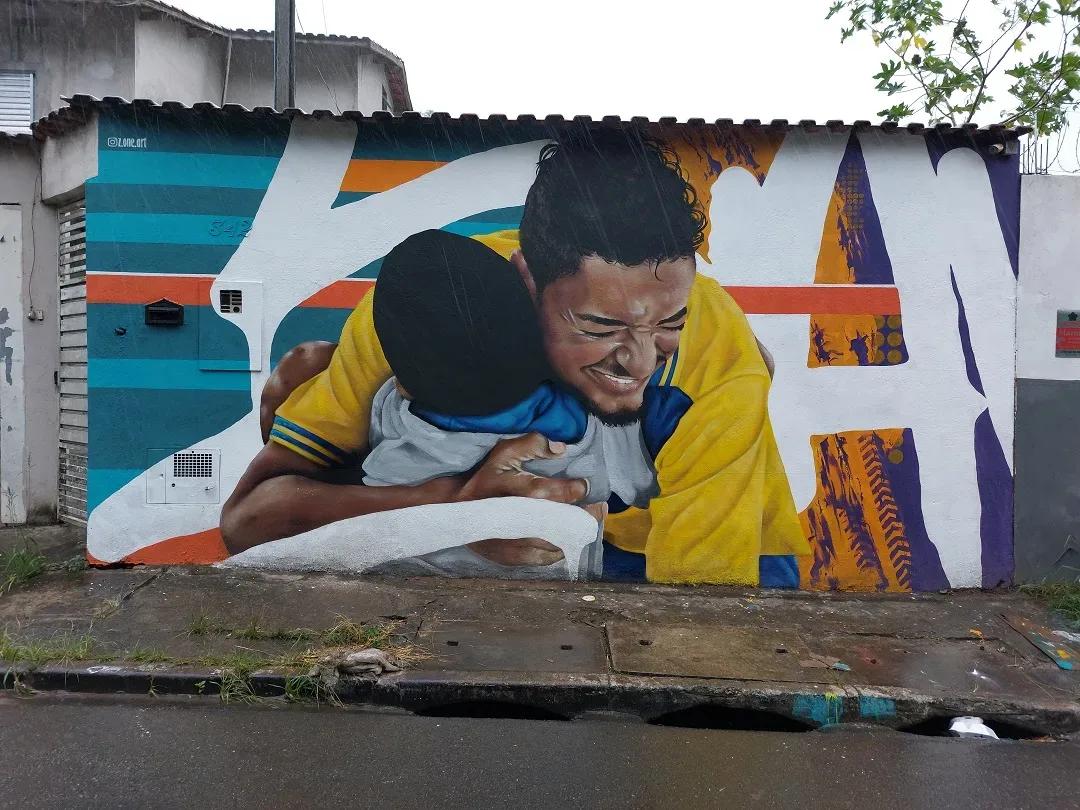
Its voice lives in the rhythm of its streets, the textures of its buildings, the traces of its people, and the images that emerge unexpectedly across its walls. From a monumental mural to a quiet stencil, from graffiti written in a single gesture to a sculpture occupying a public square, urban art transforms the spaces we move through every day.
It asks us to look again.
Urban Echoes brings together artists whose practices engage with the city as both a canvas and a living archive. Through murals, graffiti, sculpture, and public interventions, these artists explore the ways creativity can occupy, challenge, reinterpret, and reshape our shared environments.
Among the participating artists are , Abdulmalik Sultan, Demoiselle, Antonio Collantes, Boris Matas, Dezy Kouassi, Youcef , Mehdi Fahraji, Felipe Z.ONE and Douglas Small each bringing a distinct voice to the conversation around contemporary urban expression.
Urban artists work within spaces that already carry stories. Every wall has a history. Every street has its memories. Every neighbourhood has its own visual language. By intervening in these environments, artists add new layers to an existing narrative—sometimes celebrating a community, sometimes questioning its realities, and sometimes simply offering a new way of seeing.
This is where the idea of the urban echo emerges.
An artwork placed in public space does not remain contained within itself. It travels through the people who encounter it. A mural becomes part of someone's daily journey. A sculpture becomes a landmark. A piece of graffiti becomes a visual memory. An installation can transform the atmosphere of an entire space.
The work continues to speak long after the artist has left.
And sometimes, even when the artwork itself disappears, the echo remains.
Urban art has always carried this tension between permanence and impermanence. A sculpture may endure for generations, while a mural may eventually be painted over. Graffiti may exist for only a brief moment before being erased. Yet each intervention leaves something behind: an image, a feeling, a question, or a memory.
In this way, urban art becomes a form of collective storytelling.
It challenges the idea that art belongs only inside galleries and museums. It brings creativity into everyday life, placing it where people live, work, gather, and move. It creates encounters with audiences who may not actively seek out art, making the city itself a place of cultural exchange.
The artists featured in Urban Echoes remind us that contemporary urban art is not defined by one medium. It exists across disciplines and perspectives—through the scale of murals, the immediacy of graffiti, the physical presence of sculpture, and the immersive possibilities of installation.
Together, their practices reveal the city as something constantly evolving: a place where history and contemporary life meet, where personal expression becomes part of a collective landscape, and where art can change the way we understand the spaces around us.
At Niotah, Urban Echoes is an invitation to listen differently.
To look beyond the obvious.
To notice the voices embedded in walls, the stories carried by sculptures, the gestures hidden in graffiti, and the interventions that quietly reshape our surroundings.
Because cities do not simply contain art.
They remember it.
And every artist who leaves a mark in the urban landscape becomes part of that memory—adding another voice to the ongoing conversation between people, places, and time.
These are the echoes of the city.