In Islam, calligraphy represents the highest form of artistic expression. A deep devotion and respect for the sacred word transformed writing into a sublime art that preserves an innate spiritual essence. Every single stroke can be understood as a contemplation of the word of Allah, turning the act of writing into a form of dhikr-the remembrance of God-and a pure act of worship where written beauty seeks to reflect divine beauty.
As the tenth-century Cordoban poet Abu Hafs ibn Burd al-Asghar beautifully wrote,
ما أعجب شأن القلم: يشرب ظلمة ويلفظ نوراً
"How remarkable is the condition of the qalam: it drinks darkness and pours forth light."
Arabic calligraphy is the visual manifestation of love for the divine word. Hundreds of exquisite copies of the Qur'an became the ultimate documentary evidence of this art form. At the same time, its true richness and complexity can only be fully appreciated by studying the inscriptions carved onto stone, copper, ceramics, wood, and other materials, alongside legal treatises, medical texts, and the diverse writing styles that evolved under the inspired pens of the calligraphers.
For over three centuries, Kufic calligraphy was the exclusive script used to copy the Qur'an until the tenth century, when Abu Ali Ibn Muqlah, who served as vizier to three Abbasid caliphs, devised a system to redesign cursive calligraphy, granting it mathematical proportion and refined elegance based on the Nuqta- the diamond-shaped dot left by the width of the qalam tip- as the fundamental unit of measurement, alongside the alif and the circle. Later in the eleventh century, his student Ibn al-Bawwab further embellished and perfected these Six Styles of cursive writing, including Thuluth, and Naskhi -which became the preferred script for copying the Qur'an due to its balance of elegance and supreme legibility-as well as Muhaqqaq, Rayhani, Tawqi, and Riqa.
To the west of the Islamic Empire, however, the evolution of the Kufic style took a completely different path, rounding off sharp angles and expanding into generous curves. Originating in Kairouan, Tunisia, this distinct development spread to al-Andalus during the tenth century, marking the birth of the Maghribi script.
Crucially, Ibn Muqlah’s system of proportions never became popular in the West. Instead, Western Kufic evolved independently from the original script, guided by the exceptional artistic sensitivity of the peoples of the Maghreb. While the standardized eastern cursives were widely adopted in al-Andalus for state administration, chanceries, and daily court correspondence, workshops developed an independent aesthetic for sacred texts and monumental epigraphy. Andalusi masters adapted Thuluth and Naskh so thoroughly to the local aesthetic that it is entirely appropriate to classify them as Andalusi Thuluth and Andalusi Naskh, while Andalusi Kufic continued to be used for centuries, yielding extraordinarily beautiful decorative epigraphy.
This unique Andalusi identity can be traced through its historical periods:
During the Umayyad or Caliphal Period from the 8th to the 10th centuries, the script transitioned from Archaic Kufic to Florid Kufic and Simple Kufic, leaving masterworks like the inscriptions on the Córdoba Mosque's Mihrab and the intricately carved Pyxis of Zamora.
The subsequent Taifa Kingdoms and Almoravid periods in the 11th and 12th centuries balanced continuity and rupture with this simple style, showcasing a highly exuberant Florid Kufic at the Aljafería Palace in Zaragoza, while Toledo's epigraphy sat precisely on the threshold of traditional continuity and stylistic innovation.
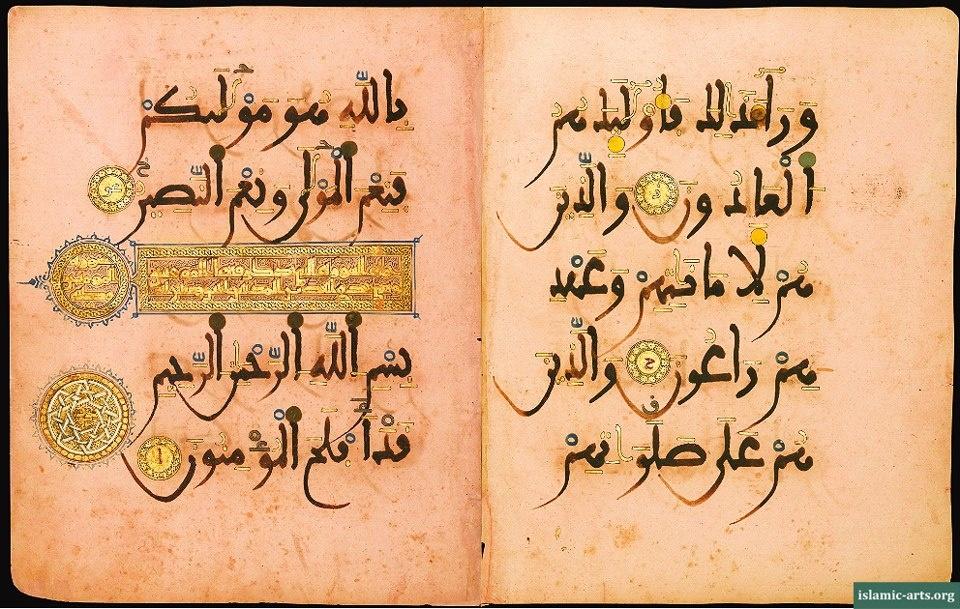
Later, the Almohads introduced numerous modifications, developing an elegant Kufic script that floated gracefully over dense backgrounds of vegetal ornamentation, while actively popularizing cursive writing to spread their unified message, as seen in the 13th-century Almohad "Pink Qur'an".
Precisely, the production of this peach-pink linen-based paper (waraq as-Satibi) in Játiva, Valencia -home to Europe's earliest documented paper mill- accelerated this Almohad scribal shift. While eastern centers like Samarkand and Baghdad used mulberry bark or cotton rags, Játiva manufactured sheets using local linen fibers. This substrate was treated with starch sizing and polished with agate stones to create a smooth, low-friction surface. Distributed as a raw commodity to imperial workshops in Seville and Marrakech, this satin-finished paper allowed the qalam to trace fluid cursive lines without snagging or bleeding ink, facilitating the production of manuscripts like the Almohad "Pink Qur'an."
Ultimately, the architecture of The Alhambra in Granada eclipses all other epigraphic manifestations, standing as the most spectacular compendium of Arabic writing in the world and the ultimate testament to Andalusi singularity. Within its walls, an immensely elegant Kufic script coexists with a highly fluid cursive script. A vast diversity of repeating patterns and motifs proliferates across the stucco, where both styles develop over a deeply profuse background of ataurique vegetal reliefs, completely blurring the line between architecture, poetry, and sacred art.