Cities are often imagined as collections of buildings, roads, and lights. Yet beneath their physical form lies another city, one that cannot be found on maps. It is constructed from memories, conversations left unfinished, expectations inherited from generations before us, and emotions that continue to bind us long after we believe we have moved on.
This painting gives shape to that invisible city.
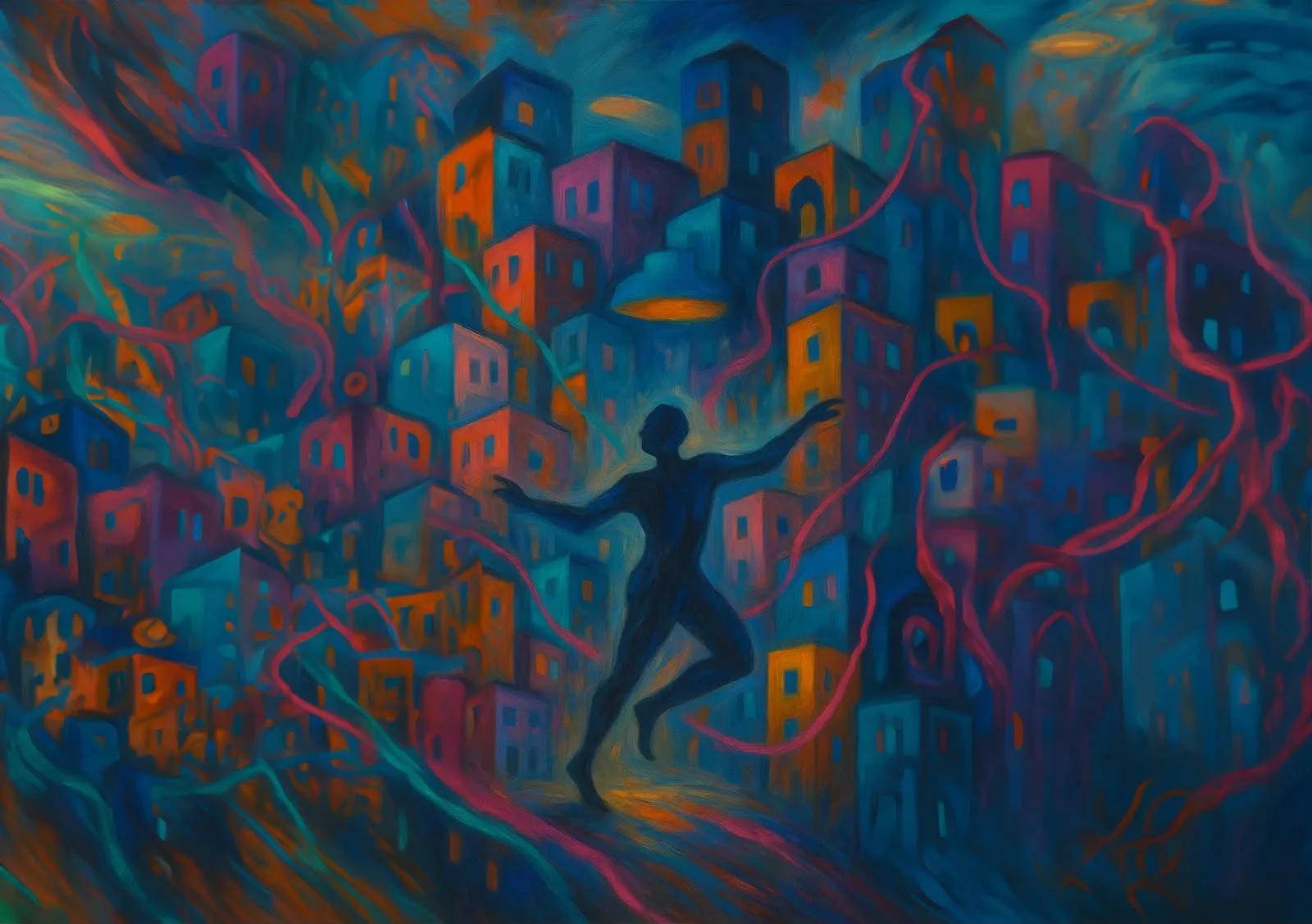
The towering blocks seem alive, leaning toward one another as if exchanging secrets. Their windows resemble silent eyes, witnessing lives that remain hidden behind walls. They are not simply homes; they are fragments of identity, each carrying traces of joy, grief, ambition, and loss. The city grows upward without order, reflecting the complexity of the human mind where memories stack upon memories until they become impossible to separate.
At the center stands a solitary figure. It does not appear trapped, nor completely free. Instead, it exists in the fragile space between surrender and transcendence. The open arms suggest acceptance rather than resistance, as though the figure has realized that escaping the city is impossible because the city now exists within.
Listening to Feel the Painting
For the full experience, listen to the accompanying piece while viewing the artwork.
https://www.youtube.com/watch?v=iBd1r5VOK2c&list=RDiBd1r5VOK2c&start_radio=1
Surrounding the figure are flowing crimson threads. These lines refuse to behave like streets or rivers. They resemble emotional currents—connections between people, places, and experiences. Some feel protective, others restrictive. They symbolize the invisible forces that shape every decision we make: family, culture, trauma, love, faith, fear, and memory. Though unseen in everyday life, they often determine the direction of our journey more than any visible path.
The vibrant blues evoke silence and introspection, while the bursts of orange and gold interrupt the darkness like moments of hope breaking through uncertainty. Together, the colors create an emotional landscape rather than a geographical one, reminding us that every external environment is ultimately filtered through our inner world.
The accompanying music deepens this experience. Rather than explaining the image, it becomes another layer of the painting itself. Its atmosphere echoes the tension between isolation and connection, between wandering and belonging. The sound fills the empty spaces between the buildings just as emotions fill the spaces between words, inviting the viewer to slow down and inhabit the work instead of merely observing it.
Ultimately, Threads Between the Walls is not about architecture—it is about the architecture of the self. It asks a quiet question: How much of the world around us have we built, and how much has been built inside us?
The answer is left suspended, somewhere between the figure reaching outward and the countless windows looking back.