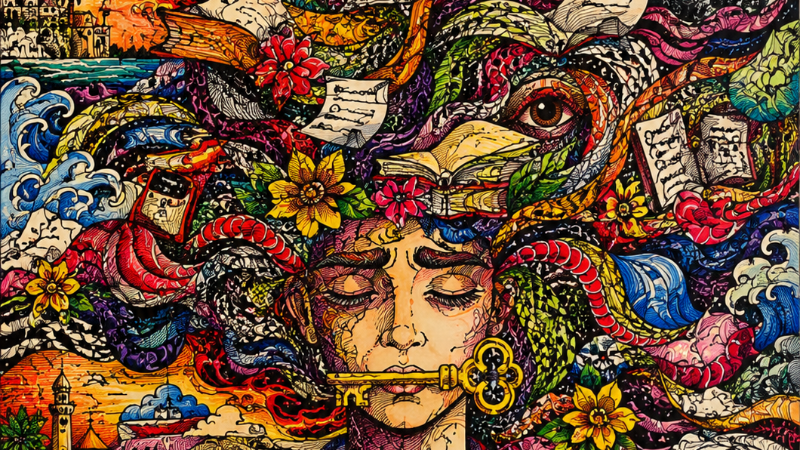
This painting explores the invisible world that exists inside the human mind—the place where memories, fears, dreams, questions, and emotions constantly collide.
At the center, the figure appears calm, yet the world surrounding them is anything but calm. Waves of color, tangled lines, flowers, eyes, clocks, buildings, storms, books, and fragments of memories flow together like thoughts that refuse to settle. The dense colored-pencil lines represent the complexity of overthinking: one thought connects to another until it becomes difficult to distinguish reality from the noise inside the mind.
The key across the mouth is the central symbol. It represents the things we choose not to say—the feelings we hide, the questions we keep inside, and the words that remain locked away. But the key carries another meaning: perhaps the person already possesses the key to their own silence and freedom, yet has not decided whether to use it.
The bright colors suggest that difficult thoughts are not always dark. Even within confusion, there can be beauty, creativity, memories, hope, and imagination. The painting therefore does not portray the mind as simply broken; it portrays it as overwhelmingly alive.
The tangled world above the figure becomes a visual representation of an inner landscape: beautiful, chaotic, painful, and deeply human.
“We are not always lost because we have no direction; sometimes we are lost because there are too many thoughts pulling us in different directions.”