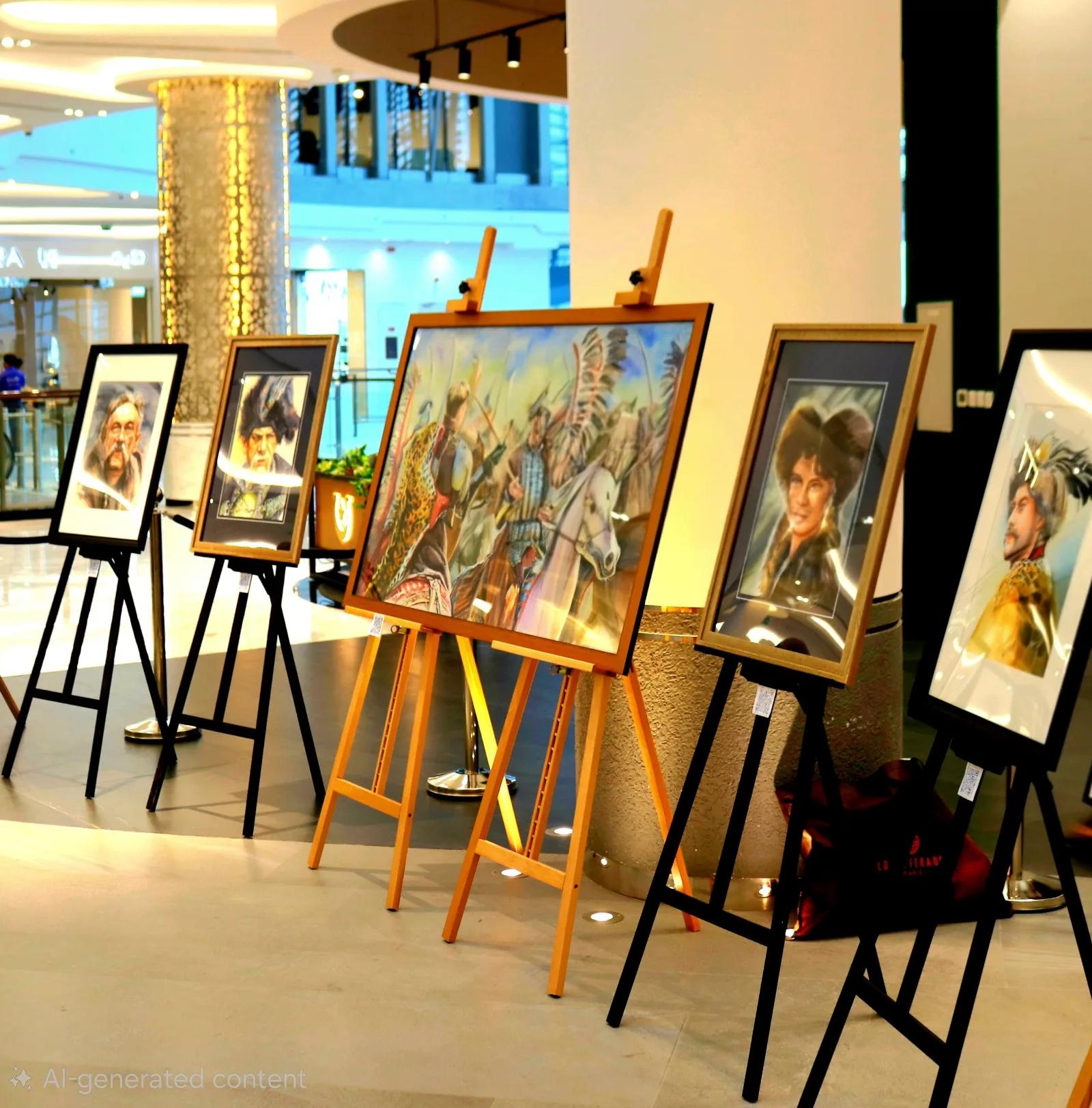
People often ask me what it is like to paint a watercolour measuring one by one metre, one by two metres, or even one by three metres. At first glance, it may seem like the same technique, only on a larger sheet of paper. In reality, it is an entirely different physical and artistic experience.
Unlike oil or acrylic, watercolour is most often painted using the alla prima technique. The washes must remain wet, colours need to flow naturally into one another, and decisions cannot be endlessly corrected. Everything depends on timing, precision and an understanding of how water behaves.
For this reason, large watercolour sheets must be placed horizontally while I work. This allows the pigments and water to move evenly across the surface instead of running downward under gravity. For abstract paintings, this position is usually not a problem. For portraits or architectural subjects, however, it becomes one of the greatest technical challenges.
When a portrait is lying flat on a table, I cannot step back and see it in its natural vertical position. Looking at the work from above introduces perspective distortion. Proportions appear different, and even small inaccuracies can become significant once the painting is displayed upright. Throughout the process, I constantly move around the work, change my viewing angle and mentally compensate for these optical effects. It requires years of experience to trust both the eye and the mind.
Large-scale watercolour is also physically demanding. Every brushstroke involves reaching across a wide surface while maintaining complete control over water, pigment and composition. Unlike many other mediums, there is little room for hesitation. The painting develops at the same pace as the drying paper.
Yet this is exactly what I love about watercolour. Its scale does not diminish its delicacy. Instead, it magnifies every quality that makes the medium unique: transparency, light, spontaneity and honesty. Every large painting becomes a balance between careful planning and the willingness to embrace what water chooses to do.
For me, creating monumental watercolours is not about making bigger paintings. It is about expanding the possibilities of a medium that is often underestimated. It is proof that watercolour can possess both monumental presence and remarkable sensitivity at the same time.