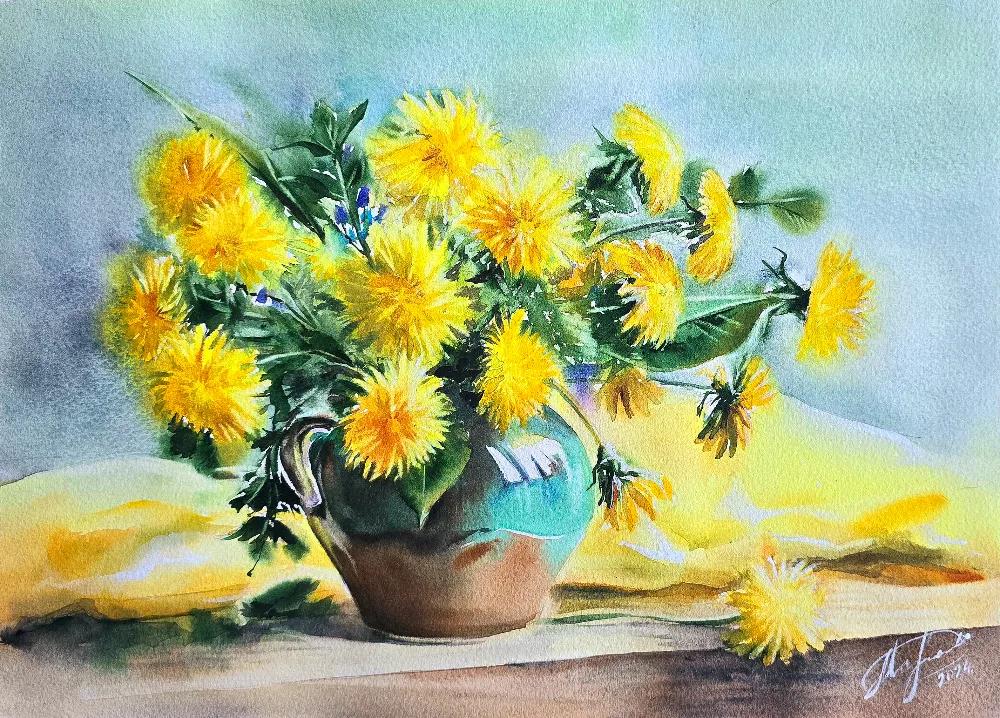
There is a unique thrill in watching raw pigment touch a completely wet sheet of paper. In that precise second, you lose absolute control. The color doesn't just sit on the surface; it explodes, creates soft, cloud-like blooms, and begins its own journey across the wet fibers. This is the essence of the wet-on-wet (alla prima) technique, a method that is less about rigid drawing and more about a fluid partnership with water.
Timing as a MaterialIn
wet-on-wet painting, time is just as important as the pigment or the brush. The paper goes through distinct stages of wetness, and each stage offers a closing window of artistic opportunity:
The Glossy Stage:
When water pools on the surface, causing pigments to rush and blend into soft, dreamlike gradients.
The Satin Stage:
When the shine begins to fade, allowing the brush to define soft edges, shadows, and subtle shapes without losing the bleeding effect.
The Matte Stage:
The critical moment where adding more water creates "blooms" or "backruns"-beautiful, organic textures that look like frost or ancient stone.
Mastering this technique means learning to read the shine of the paper and knowing exactly when to strike and when to wait.
Painting with Light and Air
Because the colors blend directly on the paper rather than on the palette, wet-on-wet creations possess a rare, breathless transparency. The pigment layers remain thin and delicate. Light passes through them effortlessly, bounces off the white paper underneath, and creates that signature internal glow that defines world-class watercolor art.
It is the perfect medium for capturing things that have no fixed shape: the heavy atmosphere of a storm, the soft glow of morning mist, or the delicate, translucent petals of a flower. You are not painting objects; you are painting the air around them.
The Zen of Surrender
Ultimately, the wet-on-wet technique is a lesson in letting go. It forces the artist to embrace the unpredictable. A stroke might bleed a bit further than intended, or two colors might mix into a completely unexpected shade.
Instead of fighting these moments, the wet-on-wet artist learns to welcome them. It is a visual record of a single, unrepeatable moment where human intent and natural physics met to create something beautiful.