Excavations: Painting as an Act of Discovery
By Detlef “Dego” Gotzens
I enter the studio with the experience of a lifetime, but I still need the painting to take me somewhere I have not been before. That possibility keeps me working.
For me, art is an expression of freedom. In the studio, I can follow an idea before I understand it, take a risk without knowing whether it will succeed, and question something I believed was resolved. After more than fifty years of working with materials and images, this freedom remains essential.
My beginnings were in Cologne, Germany, where I trained in the traditional glassmaking guild system and became a Master Glassmaker in 1977. My education combined technical knowledge with design, followed by years of work in stained glass, restoration, architectural glass and sculpture. Glass taught me to pay attention to how colour behaves in relation to light, how an individual element affects a larger structure, and how a material can resist an intention.
Painting gradually became the centre of my practice. It gave me room for a more immediate and unpredictable dialogue, while everything I had learned through glass continued to inform my eye.
Cologne was also an important artistic environment for me, particularly during the 1980s. Encounters and conversations with artists, including Sigmar Polke, belonged to a wider culture of debate that continued in studios, cafés and late into the night. What stayed with me was a willingness to question how a painting could be made and what it could contain.
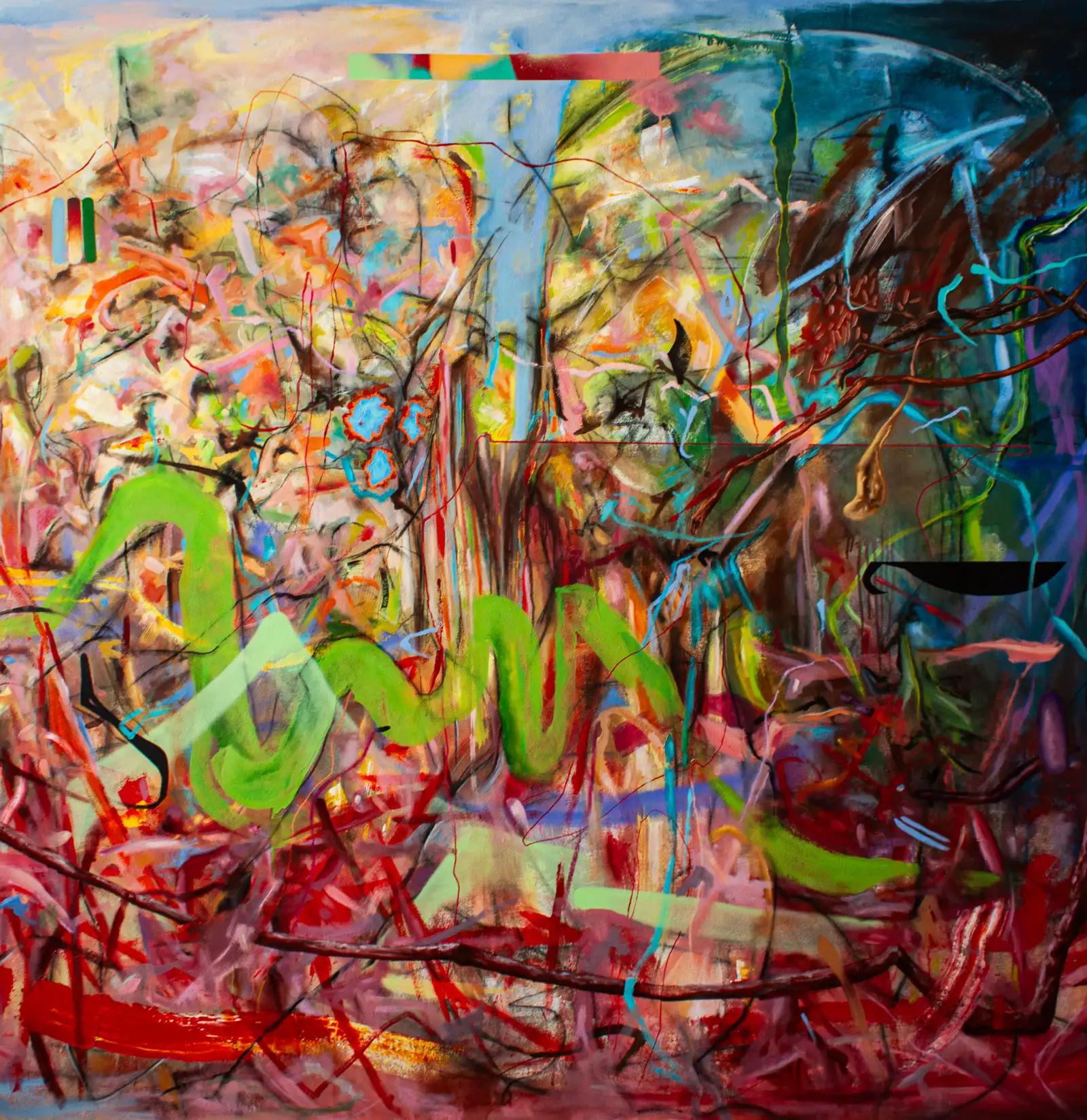
Much of my recent work belongs to an ongoing series called Excavations. The title describes something close to the experience of making these paintings. I build a surface, interrupt it, cover passages, expose others, and draw into what remains. Earlier decisions leave traces that influence everything that follows.
I think of this as a form of excavation because discovery happens through the work itself. A mark may suggest a direction I had not anticipated. An area I thought was finished may need to disappear. Something almost lost beneath several layers may become essential to the painting.
Memory enters through these accumulated traces. Experiences, places and images become entangled with decisions made in the present. I rarely need to identify every association. I am interested in allowing them to act upon one another and acquire a visual life.
My process generally unfolds in three stages. The beginning is fast and instinctive. I establish movement, colour and a structure that gives me something to respond to. This is followed by a much longer period of looking, changing and questioning. I may return to a painting repeatedly, trying to understand what it needs and where I am merely repeating myself.
The final stage can involve very little physical activity. A few marks, an erasure or a change of colour may bring the whole surface into a relationship I had been searching for. Knowing when to stop requires as much attention as knowing what to do next.
Colour carries much of that dialogue. It can establish depth, create resistance, hold an area together or pull it apart. In paintings such as Excavations Energy and Excavations Entangled, I explore how strong colour and restless drawing can coexist with a structure that holds the viewer’s attention. I want the eye to move, discover connections, and return to passages that reveal themselves slowly.
Working between Canada and Florida has brought different experiences of light and place into my practice. The Florida Vibes paintings, and more recent works associated with After the Rain, reflect my response to those surroundings. Sometimes a shift in the atmosphere finds its way into a painting before I consciously recognize it. I have found myself thinking about “excavating light”—discovering how it might emerge through a worked and layered surface.
Although abstraction occupies much of my practice, figurative painting remains an active part of it. A face, a body, or a landscape presents another way to investigate the same questions of space, memory and perception. Historical paintings also continue to provoke new work.
My painting The Massacre of the Innocents, made over eighteen months in 2017–2018, grew from a longstanding engagement with Rubens. As a boy, I was captivated by the force and complexity of his compositions. I made drawings after individual figures and details, trying to understand how painted forms could carry such movement and emotion. Returning to that imagery decades later meant bringing my own experience and visual language into contact with it. The resulting work became a sustained encounter with the subject and with painting itself.
Whether I am working with an abstract surface or a recognizable figure, I need room for something unexpected to happen. Experience helps me make decisions, but it can also make familiar solutions too readily available. I look for the moment when a painting challenges that familiarity and asks me to go further.
Recently, a visitor looking at my work described it as “absolutely you.” I had not thought about it in quite that way. From inside the process, I am occupied with individual decisions, doubts and discoveries. Someone encountering the finished painting sees those decisions together. They may recognize a continuity that I experience simply as the ongoing necessity of working.
I hope the paintings reward that kind of attention. Their scale may invite an immediate physical response, while their layers offer a slower encounter. Viewers bring their own memories and associations, and I value the conversations that begin when something in the work connects with an experience I could never have anticipated.
The studio remains the place where I can pursue these questions fully. There is always another surface, another difficult passage, another possibility that I cannot yet see clearly.
The ability to return and continue is, for me, a meaningful measure of success.
Detlef “Dego” Gotzens is a German-born Canadian artist working in painting, sculpture and architectural glass, with studios in Canada and Florida.
Instagram: @degoarts